The post-war estates
Great Baddow grew in the 1950s with the Rothmans Estate, put up for workers at Marconi and English Electric Valve — streets of solid, unshowy family houses that are now reaching the age where the original windows have been replaced once already.
That first replacement is usually what owners want to undo. A stepped sash sits proud of its frame and casts a shadow line the original never had, which is the detail that makes a 1950s elevation look re-fitted rather than maintained.
Why flush, and what it is not
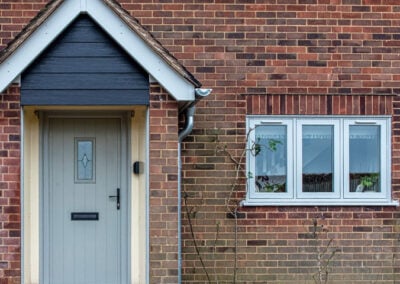
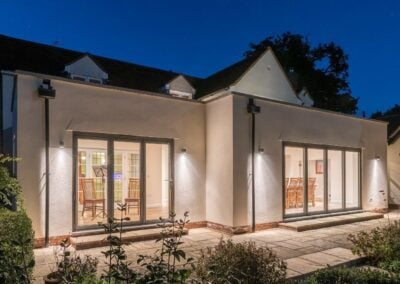
A flush sash closes level with the outer frame, so the elevation reads as one plane. It is not a vertical slider and not a reproduction box sash: it is a casement finished the way timber casements were traditionally made, before stepped profiles became common.
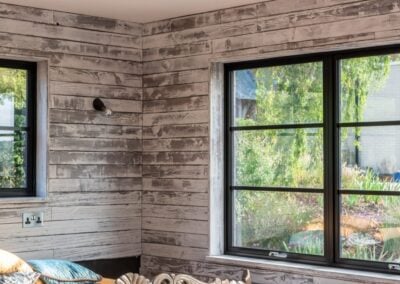
The things that decide whether it convinces are small. Mechanically jointed corners read closer to timber than a welded-and-cleaned joint. Dummy sashes let a fixed light match its opening neighbours. Hardware shows more than people expect: hinges and stays are on view whenever a window is open, and the handle is the part you touch every day, so choosing their finish to suit the house matters as much as the profile does.
Finish matters at the same scale. A woodgrain foil and a smooth painted-look finish read very differently at arm’s length, and with no shadow line to distract the eye that texture is a larger part of the result than it would be on a stepped window.
For a house where the period detail is the point, our piece on Smarts Alitherm Heritage 47 covers the same problem solved in aluminium, with slimmer sightlines.
Getting to you
Chelmsford is about 35 to 40 minutes from our Colchester showroom along the A12. On a flush sash job the thing to settle on site is how deep the frame sits in the reveal, because the flat face only reads properly at the right depth — and on an estate where neighbours share an elevation, which existing openings set the standard for the rest.
See the range on our flush casement windows page, or get an estimate first.